
The 5% Effect:
How to Engineer
"Geometric Growth" for Your Clients
It Started with a "Laughingstock."
For 110 years, British Cycling was a failure.
Zero Tour de France wins.
Zero respect.
Then, in 2010, Dave Brailsford took over with a radical new theory:
The Aggregation of Marginal Gains.
He didn't try to reinvent the bicycle. He simply improved 100 tiny details by just 1%. He optimized tire grip, pillow comfort, hand-washing protocols, and muscle recovery gels.
Critics thought it was obsessive. Then they won!
They won the Tour de France in 2012.
Then again, in 2013, 2015, 2016, 2017, 2018, and 2019.
They proved that Geometric Growth beats Linear Effort - EVERY TIME!
Read the full story and the principle behind TIMBUC’s approach (Whitepaper below).

The Simple Logic (math)

If you improve one area of your business by 20%, it’s a great win. But if you improve 20 different areas by just 1% each, the cumulative effect is often much greater and more resilient because the business is now optimized at every level.
Mathematically, this is the difference between linear growth and geometric (compound) growth.
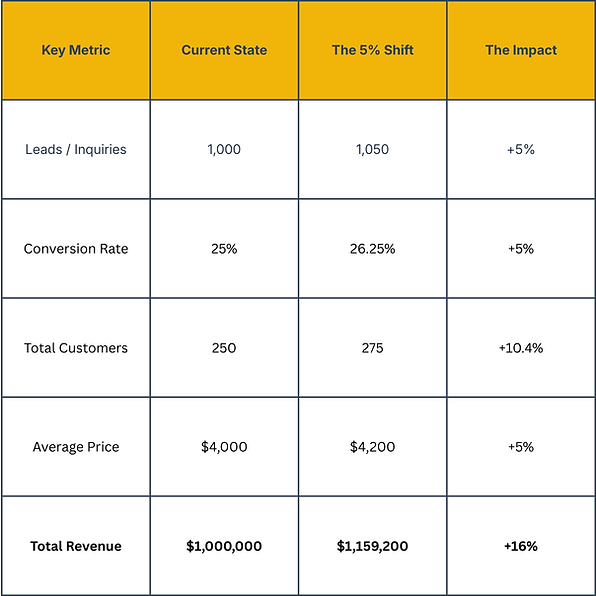
The Compounding Secret
This table demonstrates the "surplus" created when you stop looking for a single 20% miracle. By adjusting just three variables by a modest 5%, we didn't just see a linear increase—we unlocked a 16% revenue surge.
But this is only a partial view. The TIMBUC Premise tracks seven core mathematical levers. When the remaining variables are introduced, the growth curve shifts from a steady climb to a vertical breakthrough.
The math is simple, but the results are often hard to believe until you see the "X-Ray" used on one of your prospects' businesses. If you would like to learn more, including the seven levers and how to build a "Sky Team" style infrastructure for your clients, then download the Whitepaper below.
It’s not about doing one thing 100% better, it’s about doing 100 things 1% better."
— Sir Dave Brailsford
